 English
 Español
  Português
  русский
  Français
  日本語
日本語  Deutsch
  tiếng Việt
  Italiano
  Nederlands
  ภาษาไทย
  Polski
  한국어
한국어  Svenska
  magyar
  Malay
Malay  বাংলা ভাষার
  Dansk
Dansk  Suomi
Suomi  हिन्दी
  Pilipino
  Türkçe
  Gaeilge
  العربية
  Indonesia
  Norsk
Norsk  تمل
تمل  český
český  ελληνικά
  український
  Javanese
  فارسی
فارسی  தமிழ்
தமிழ்  తెలుగు
  नेपाली
  Burmese
  български
  ລາວ
ລາວ  Latine
  Қазақша
  Euskal
  Azərbaycan
  Slovenský jazyk
  Македонски
  Lietuvos
  Eesti Keel
  Română
  Slovenski
  मराठी
मराठी  Srpski језик


How Can Air Purifiers For Pets And Allergies Help Create a Cleaner, Healthier Home
For pet owners seeking cleaner indoor air, Basy offers practical air purification solutions designed to address pet dander, airborne particles, and everyday odors. Choosing the right Air Purifiers For Pets And Allergies can help reduce airborne irritants and create a more comfortable living environment for families and their furry companions.
Pets bring companionship and joy, but they can also introduce airborne allergens, loose fur, and persistent odors into the home. An effective air purifier combines suitable particle filtration, odor control, and sufficient airflow to help manage these challenges. This guide explains how pet-focused air purification works, which features matter most, how to choose a suitable unit, and how to maintain it for consistent performance. It also explores Basy's portable air purification solutions, including multi-layer filtration, smart controls, real-time air quality monitoring, and adjustable fan speeds, to help homeowners and commercial buyers make informed purchasing decisions.
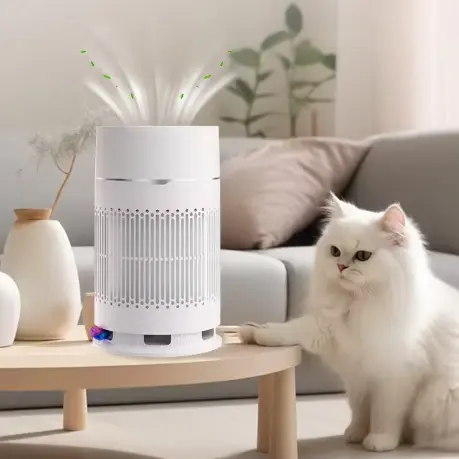
Table of Contents
1. Understanding Pet Allergens and Indoor Air Quality
2. How Air Purifiers For Pets And Allergies Work
3. Essential Features to Look For
4. Comparing Air Purifier Features
5. How to Choose the Right Air Purifier
6. Placement and Maintenance Tips
7. Why Consider Basy Air Purification Solutions?
1. Understanding Pet Allergens and Indoor Air Quality
Indoor air quality can be affected by many everyday activities, particularly in homes with cats, dogs, and other furry animals. Pet-related particles may circulate through the air, settle on furniture, or accumulate in carpets and bedding. Understanding these pollutants is the first step toward choosing an effective air cleaning solution.
Common Airborne Irritants in Pet-Friendly Homes
- Pet dander: Tiny flakes of skin shed by animals can become airborne and contribute to allergic reactions in sensitive individuals.
- Pet-related proteins: Proteins found in animal saliva, skin flakes, and urine can trigger allergic symptoms. They may transfer to surfaces and become airborne again.
- Loose fur: Larger hair particles can collect dust and transport other debris around the home, although visible fur is not the only source of pet allergies.
- Dust and pollen: Pets may bring outdoor particles indoors on their coats and paws, adding to the existing allergen load.
- Household odors: Litter boxes, pet bedding, and damp coats can produce unpleasant smells that require a different filtration approach from particle removal.
These pollutants require different management strategies. Regular vacuuming and washing pet bedding help remove settled debris, while a suitable air purifier can capture some airborne particles before they settle. For persistent allergy symptoms, consult a qualified healthcare professional because air purification alone cannot eliminate every allergen or treat an underlying medical condition.
2. How Air Purifiers For Pets And Allergies Work
Air purifiers draw indoor air through filtration materials and return treated air to the room. Their effectiveness depends on the filter design, airflow rate, room size, maintenance schedule, and the type of pollutants being targeted.
Multi-Layer Filtration for Different Particle Sizes
A well-designed filtration system may use several layers to handle different contaminants:
- Pre-filter: Captures larger particles, including some loose hair, lint, and dust. It can help prevent the main filter from becoming clogged too quickly.
- High-efficiency particle filter: A properly specified HEPA filter can capture fine airborne particles, including many particles carrying pet allergens, as air passes through the filter.
- Activated carbon filter: Adsorbs certain gaseous pollutants and odors. Its performance depends on the amount and quality of carbon and the specific compounds involved.
Not every air purifier includes all three components. Buyers should check the actual filtration specifications rather than relying on general phrases such as advanced purification or allergy protection.
Particle Removal Versus Odor Reduction
Particle filtration and odor control serve different purposes. A particle filter helps capture airborne dust and dander, whereas activated carbon is commonly used to reduce certain odors. Neither function should be assumed to eliminate every pollutant.
For a broader indoor air quality strategy, combine filtration with source control, routine cleaning, appropriate ventilation, and prompt removal of pet waste. Avoid relying on fragrance alone to conceal unpleasant smells.
3. Essential Features to Look For
When evaluating Air Purifiers For Pets And Allergies, prioritize measurable performance and practical usability over decorative features. The following factors can help narrow down suitable options.
Room Coverage and Clean Air Delivery
Choose a unit that can handle the intended room size. Check its clean air delivery rate (CADR), recommended room area, and air changes per hour where available. A purifier that is too small for the room may not circulate and clean the air quickly enough to meet your needs.
Noise Level and Adjustable Fan Speeds
Bedrooms, nurseries, and home offices benefit from quieter operation. Multiple fan speeds allow users to balance airflow and noise according to the time of day. A low-noise mode can be useful at night, while a higher setting may be appropriate during cleaning or periods of increased airborne particles.
Smart Controls and Air Quality Monitoring
Modern units may offer remote controls, mobile app operation, timers, automatic fan adjustment, and built-in air quality displays. These features can make routine operation more convenient. However, a sensor reading should be interpreted according to the pollutants the sensor can actually detect.
Filter Replacement and Running Costs
Replacement filters are an important part of the total cost of ownership. Before buying, check filter availability, replacement intervals, cleaning requirements, electricity consumption, and the cost of maintaining the unit over time.
4. Comparing Air Purifier Features
The table below summarizes the main functions to consider when comparing air purifiers for pet owners and allergy-sensitive households.
| Feature | Main Function | Why It Matters | What to Check |
|---|---|---|---|
| Pre-filter | Captures larger debris and some pet hair | Helps reduce the particle load reaching the main filter | Whether it is washable or replaceable |
| HEPA filtration | Captures fine airborne particles | Helps reduce airborne particles that may carry allergens | Filter specification and verified performance |
| Activated carbon | Adsorbs certain odors and gases | Supports odor management in pet-friendly rooms | Carbon quantity and replacement requirements |
| Suitable room coverage | Supports adequate air circulation and cleaning | Helps match performance to room size | CADR and recommended room area |
| Adjustable fan speeds | Changes airflow according to operating needs | Balances cleaning performance and noise | Available speed settings and sound levels |
| Air quality monitoring | Displays readings from supported sensors | Helps users understand changes in measured air quality | Sensor type and automatic control options |
| Filter reminder | Indicates when filter maintenance may be needed | Helps maintain consistent operation | Reminder method and reset procedure |
Important: No single feature guarantees better results in every home. Overall performance depends on the combination of filtration efficiency, airflow, room conditions, correct placement, and regular maintenance.
5. How to Choose the Right Air Purifier
The best choice depends on the household's main concern, the size of the space, and how the room is used. Consider the following practical scenarios before selecting a model.
For Homes With Cats and Dogs
Look for a unit with a pre-filter for larger particles, efficient particle filtration for airborne dander, and an optional carbon stage for pet-related odors. Homes with heavy shedding may need more frequent pre-filter cleaning. Remember that air purifiers are not a substitute for removing hair from carpets, sofas, and pet bedding.
For People Sensitive to Pet Allergens
Prioritize a well-specified HEPA filtration system and sufficient clean air delivery. Consider placing the purifier in the bedroom or another frequently occupied room, especially if that space can be kept relatively free of dust and pet debris.
For Small Apartments and Bedrooms
A compact, portable model may be easier to position and operate in a smaller space. Check its actual coverage rating, operating noise, filter availability, and energy consumption. A portable unit should not be assumed to clean an entire home equally well when doors separate different rooms.
For Offices, Hotels, and Commercial Buyers
Commercial purchasers should evaluate operating schedules, maintenance requirements, voltage compatibility, packaging, order quantities, and after-sales support. Importers and distributors may also need OEM or ODM options, depending on their market and product requirements.
To compare suitable options, review Basy's Air Purifiers For Pets And Allergies product page alongside its portable HEPA-filter pet air purifier information.
6. Placement and Maintenance Tips
Even a capable air purifier can deliver disappointing results if it is poorly positioned or neglected. Consistent operation and proper maintenance help the equipment perform as intended.
Position the Unit for Effective Airflow
- Place the purifier in the room where people spend the most time or where allergen exposure is a particular concern.
- Keep air inlets and outlets clear of curtains, furniture, walls, and other obstructions, following the manufacturer's instructions.
- Use the unit consistently rather than switching it on only when odors become noticeable.
- Consider separate units for rooms that are frequently occupied but separated by closed doors.
Maintain Filters and Reduce Allergen Sources
- Inspect and clean the pre-filter according to the product manual.
- Replace the main filter at the recommended interval or when its condition indicates replacement is necessary.
- Wash pet bedding regularly and vacuum floors, upholstery, and carpets with suitable equipment.
- Groom pets in an appropriate area and remove accumulated hair before it spreads throughout the home.
- Address moisture problems and other pollutant sources instead of expecting an air purifier to solve them alone.
Do not wash a filter unless the manufacturer specifically identifies it as washable. Improper cleaning can damage filtration materials and reduce performance.
7. Why Consider Basy Air Purification Solutions?
Basy provides home appliance solutions for customers seeking practical air cleaning equipment for residential and commercial environments. Its portable pet air purifier information describes a multi-layer filtration system designed to address pet-related particles, odors, and other airborne contaminants.
Features Designed for Everyday Convenience
Depending on the selected configuration, Basy's portable pet air purifier range includes features such as:
- Multi-layer composite filtration for pet-related particles and selected indoor pollutants.
- Adjustable fan speeds to accommodate different operating conditions.
- Button controls, remote control, and smart app operation on supported configurations.
- Air quality monitoring and automatic fan adjustment on supported versions.
- Timer functions and filter reminders to simplify routine use.
- Low-noise operation designed for home and bedroom environments.
The product page identifies model BX-98 and also references customizable configurations. Buyers should confirm the precise specification of the selected model before ordering, including filter construction, room coverage, noise performance, and supported smart functions.
Flexible Supply and Customization Options
For international buyers, Basy describes bulk procurement, wholesale cooperation, and OEM/ODM customization services. These options may be relevant to importers, distributors, retailers, and businesses developing private-label home appliance products.
The product page also lists CE, FCC, and RoHS certifications for the referenced product. Buyers should request the applicable documentation and verify that the certificates and test reports correspond to the exact model and configuration being purchased.
For product specifications and configuration details, visit the Basy portable pet air purifier page.
8. Frequently Asked Questions
1. Do air purifiers help with pet allergies?
Yes. An appropriately sized air purifier with effective particle filtration can reduce some airborne pet allergens, including particles carrying dander. Results depend on airflow, filter performance, room size, and maintenance. Air purification should complement other allergen-reduction measures rather than replace medical advice.
2. Which filter is best for pet dander?
A properly specified HEPA filter is a strong option for capturing fine airborne particles, including many particles associated with pet dander. A pre-filter can capture larger debris, while activated carbon may help manage certain pet odors. The best combination depends on the household's specific needs.
3. Can an air purifier remove pet hair?
An air purifier may capture some airborne hair, especially when equipped with a suitable pre-filter and an effective air intake. However, most pet hair settles quickly on floors, furniture, and fabrics. Regular vacuuming and cleaning remain essential for removing accumulated hair.
4. Will an air purifier eliminate pet odors completely?
Not necessarily. Activated carbon filtration can help reduce certain odors, but effectiveness varies with the amount of carbon, the type of odor, airflow, and pollutant concentration. Removing the source of the smell and cleaning affected surfaces are also important.
5. Where should I place an air purifier for pet allergies?
Start with the bedroom or another frequently occupied room. Position the unit according to its airflow requirements and avoid blocking the intake or outlet. If several rooms need treatment, consider their individual sizes and whether air can circulate freely between them.
6. How often should air purifier filters be replaced?
Replacement frequency varies by model, filter type, operating hours, and indoor pollution levels. Follow the manufacturer's instructions and check filter reminders where available. Homes with multiple pets or heavy shedding may require more frequent pre-filter cleaning and closer monitoring of filter condition.
7. What should wholesale buyers confirm before ordering from Basy?
Wholesale buyers should confirm the model number, filtration specifications, room coverage, voltage and frequency, available controls, noise performance, filter replacement costs, certification documentation, packaging, lead time, and minimum order quantity. Buyers seeking customized products should also confirm branding, design requirements, sample approval, and the agreed production specifications.
9. Final Thoughts
Choosing suitable Air Purifiers For Pets And Allergies starts with understanding the difference between airborne particles, pet odors, and settled hair. Effective particle filtration, adequate room coverage, convenient controls, and consistent maintenance can all contribute to cleaner indoor air. By combining a suitable purifier with regular cleaning and responsible pet care, households can better manage common indoor air quality challenges. If you are looking for a portable pet air purifier or exploring wholesale and customized appliance options, visit Basy's product pages and contact us to discuss your requirements, request detailed specifications, and identify a configuration suited to your market or home.
Send Inquiry
X
We use cookies to offer you a better browsing experience, analyze site traffic and personalize content. By using this site, you agree to our use of cookies.
Privacy Policy
-
Email
-
Call Us
-
Address
NO.2 Meiwang Road, Meilin Street, Ninghai, Ningbo, China
Inquiry For PriceList
Need customized home appliances? Send inquiry to Basy Appliances. Factory direct low price for vacuum cleaner, air purifier, bladeless fan, carpet cleaner machine, portable spot cleaner, high pressure washer, swimming pool cleaner.
Copyright © 2026 Ningbo Basy Electric Appliances Co., Ltd. All Rights Reserved